
Choosing the right heat shrink tubing is important for reliable electrical insulation, cable protection, and long-term performance. Two commonly used options are dual wall heat shrink tubing and non-adhesive heat shrink tubing. Understanding their differences helps you select the right solution for your application.
What Is Dual Wall Heat Shrink Tubing?
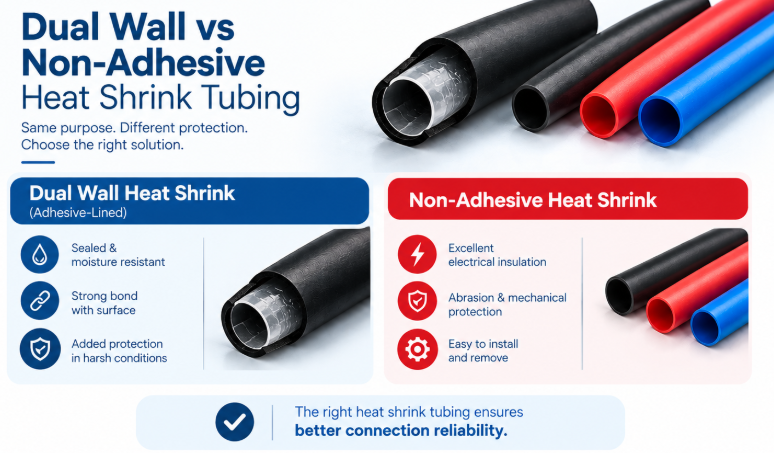
Dual wall heat shrink tubing, also called adhesive-lined heat shrink, features an outer insulating layer and an inner hot-melt adhesive layer. When heated, the tubing shrinks and the adhesive melts, creating a secure bond and helping provide moisture resistance and environmental sealing.
It is commonly used for automotive wiring, cable joints, wire splicing, electrical connections, and cable protection where additional sealing is required.
What Is Non-Adhesive Heat Shrink Tubing?
Non-adhesive heat shrink tubing has a single insulating layer without an adhesive lining. It provides excellent electrical insulation, abrasion resistance, mechanical protection, and wire bundling. It is suitable where sealing against moisture is not the primary requirement.
Dual Wall vs Non-Adhesive Heat Shrink
The key difference is environmental sealing. Dual wall tubing offers insulation combined with adhesive sealing, while non-adhesive tubing focuses primarily on insulation and mechanical protection.
Choosing the correct heat shrink sleeve can improve connection reliability, durability, and protection across electrical and industrial applications.


