Both PTFE (Teflon) and PVDF (Kynar) are high-performance fluoropolymers used in demanding industrial environments, but they serve distinct operational needs. Key Comparison Property	PTFE (Teflon)	PVDF (Kynar) Operating Temp	-200°C to +260°C	-55°C to +150°
07 Aug 2026

PTFE (Teflon) vs. PVDF (Kynar): Key Differences in Heat Shrink Tubing

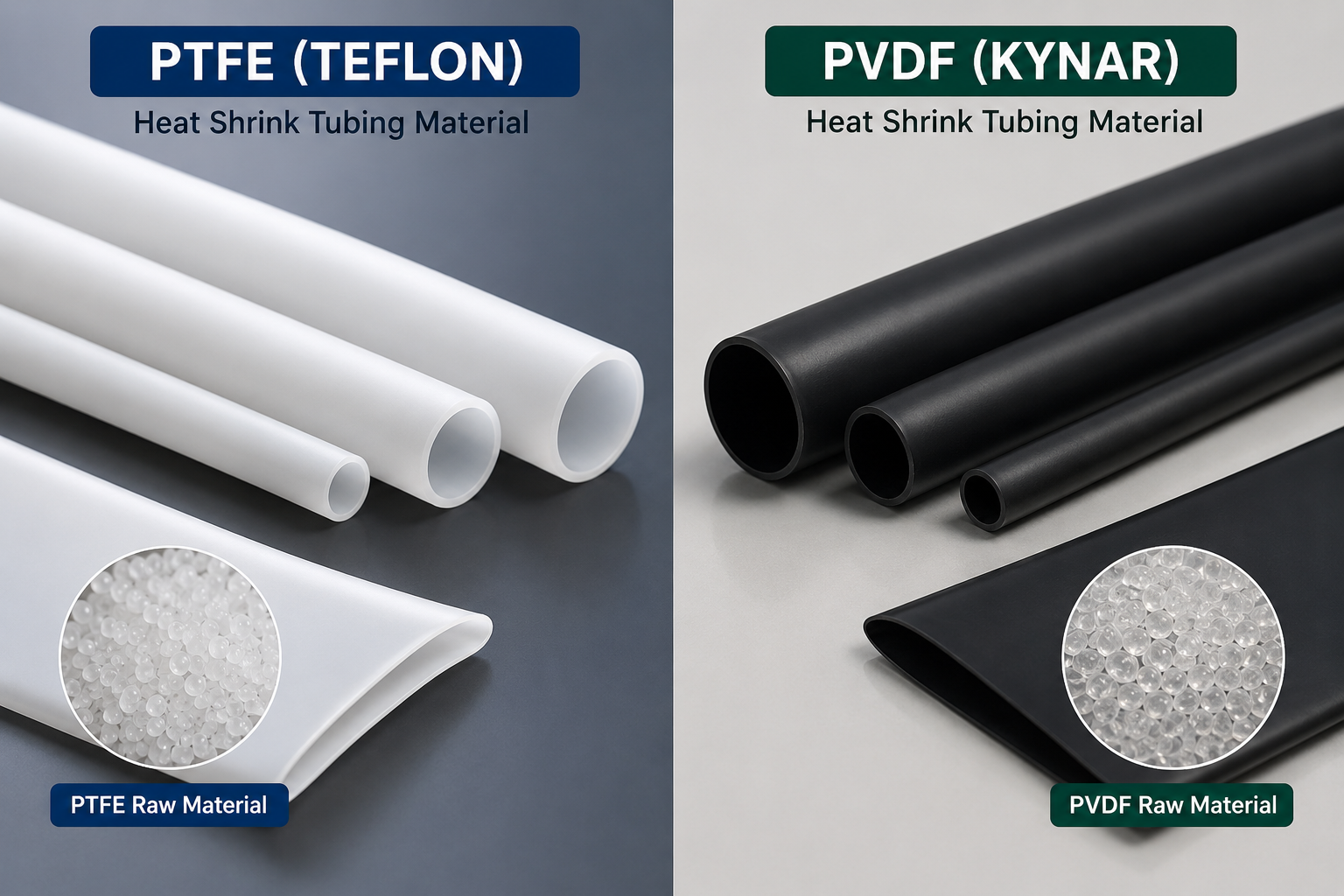
Both PTFE (Teflon) and PVDF (Kynar) are high-performance fluoropolymers used in demanding industrial environments, but they serve distinct operational needs.

Key Comparison

Property

PTFE (Teflon)

PVDF (Kynar)

Operating Temp

-200°C to +260°C

-55°C to +150°C

Chemical Resistance

Extreme (universal)

High (most solvents)

Abrasion & Strength

Good / Moderate

Superior / High

Flexibility

Rigid

Flexible

Friction

Ultra-low (non-stick)

Low

Relative Cost

Higher

Economical


Selection Guide

  • Choose PTFE (Teflon) if:
    • Your application faces extreme temperatures (up to +260°C) or aggressive solvents.
    • You require ultra-low friction or non-stick surface properties.
    • Typical Uses: Aerospace, semiconductor manufacturing, medical devices, and laboratory equipment.
  • Choose PVDF (Kynar) if:
    • You need high mechanical strength, flexibility, and cut-through resistance.
    • The tubing will undergo frequent movement, mechanical wear, or outdoor UV exposure.
    • Typical Uses: Automotive wiring, telecom, military electronics, and industrial cable protection.

Summary

Select PTFE when operating conditions involve extreme heat and harsh chemicals where performance overrides cost. Choose PVDF when you need a balance of toughness, flexibility, physical durability, and cost-efficiency.

Both PTFE (Teflon) and PVDF (Kynar) are high-performance fluoropolymers used in demanding industrial environments, but they serve distinct operational needs.

Key Comparison

Property

PTFE (Teflon)

PVDF (Kynar)

Operating Temp

-200°C to +260°C

-55°C to +150°C

Chemical Resistance

Extreme (universal)

High (most solvents)

Abrasion & Strength

Good / Moderate

Superior / High

Flexibility

Rigid

Flexible

Friction

Ultra-low (non-stick)

Low

Relative Cost

Higher

Economical


Selection Guide

  • Choose PTFE (Teflon) if:
    • Your application faces extreme temperatures (up to +260°C) or aggressive solvents.
    • You require ultra-low friction or non-stick surface properties.
    • Typical Uses: Aerospace, semiconductor manufacturing, medical devices, and laboratory equipment.
  • Choose PVDF (Kynar) if:
    • You need high mechanical strength, flexibility, and cut-through resistance.
    • The tubing will undergo frequent movement, mechanical wear, or outdoor UV exposure.
    • Typical Uses: Automotive wiring, telecom, military electronics, and industrial cable protection.

Summary

Select PTFE when operating conditions involve extreme heat and harsh chemicals where performance overrides cost. Choose PVDF when you need a balance of toughness, flexibility, physical durability, and cost-efficiency.

Our Trusted Customers

Client Logo
Client Logo
Client Logo
Client Logo
Client Logo
Client Logo
Client Logo
Client Logo
Client Logo
Client Logo
Client Logo
Client Logo
Client Logo
Client Logo
Client Logo
Client Logo
Client Logo
Client Logo
Client Logo
Client Logo
Client Logo
Client Logo
Client Logo